
 Dorado Software Redcell System Commander
Complete Data Center Control for System Administrators
| Dorado Software Products | ||
|---|---|---|
| Redcell System Commander | ||
| Redcell System Commander | Get a Quote Today! |  |
Overview:
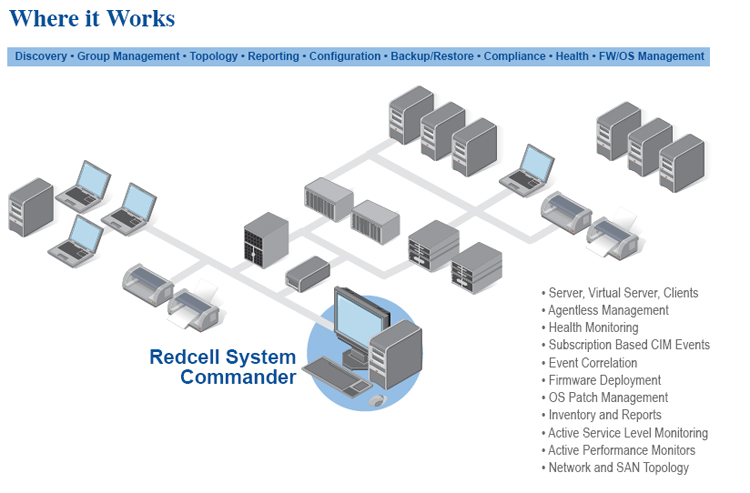
Redcell System Commander provides a single unified view for health monitoring, compliance auditing, troubleshooting, patching and agentless management of multi-vendor client and server environments. Key functions include deep system discovery, inventory management and reporting, real-time configuration, health management, remote access and control, and performance monitoring.
The deep discovery feature provides comprehensive visibility of server and client resources. Redcell synchronizes this information with its database to provide a complete picture of assets and dependencies that can appear in highly customizable reports. Additionally with Redcell, administrators can create and customize a variety of topology views:logical, geographic and "containerized." Automated logical views let you "drill down" with a mouse click to subcomponents within those that appear in topology.
Real-time device configuration management normalizes multi-vendor environments and can greatly reduce the cost ofmaintaining, licensing, and training IT staff about multiple point solutions. Redcell presents a single pane of glass view of the datacenter and provides IT administrators with the power and flexibility to manage it via a customizable permission based graphical user interface (GUI).
Redcell supports system health monitoring and remote management through WMI and WBEM interactions, SNMP traps, and any system with a BMC (Baseboard Management Controller) compatible with IPMI v1.5 or above. IPMI allows a standards-based approach for monitoring health and remotely managing heterogeneous system types independent of both OS type and power state. Redcell can also integrate seamlessly into existing framework deployments by acting as a consolidation point for SNMP or SYSLOG events from previously deployed 3rd party agents.
By selecting from the key performance indicators available in Redcell Systems Commander, you can monitor and chart key subsystems such as processor, memory, network interface and disks to identify bottlenecks, provide insights for redeploying applications, and identify systems that need to be upgraded, redeployed or retired.
Consistent with all Redcell products, the Redcell Systems Commander automates an audits configuration processes with group operations---one-to-many capabilities that reduce errors and increase productivity. Examples of automation include applying configuration and security changes to groups of systems, OS/Firmware updates and many other operations.
Where It Works:
Features:
Easy Management Server Installation
- Consolidates deep management capabilities on a single server installation, that accommodates lifecycle management needs for thousands of devices.
- Upgrade options are available for distributed, clustered, or high availability deployments.
Agentless System Management
- Device Driver architecture provides deep insight and control of managed devices using standards-based and vendor-supplied instrumentation without deploying agents on managed systems.
- Monitoring for IPMI v1.5 capable systems allows for in/out of band monitoring and management independent of power or OS state
Deep System Discovery
- Flexibility to discover your environment many different ways including via subnet, IP range, IP address or host name.
- Discovers both physical and logical components are discovered for physical and virtual systems.
Change/Compliance Management
- Quickly detect changes to the IT environment through event-driven or proactive change monitoring.
- Provides comprehensive reporting of configuration changes. These reports include what changed, who made the change, when the change was made and authorization status.
Health Management
- Standards-based health management via WMI/WBEM, SNMP, Syslog and IPMI Patching Provisioning and Compliance Auditing Consolidate remote deployment of system OS, FW, and BIOS patches.
Inventory Management and Reporting
- Advanced reporting capabilities for asset tracking and configuration management.
Remote Access and Control
- Direct-access management capability for added control and flexibility remotely control reboot, power cycling and power state on managed systems.
Performance Monitoring
- Proactively monitor key system performance metrics to identify bottle necks and performance trouble spots.
Topology
- Visualize interrelationships of managed systems and underlying infrastructure down to the interconnect level.
- Customizable topology map for single site or multi-region geographical illustration.
Group management
- Group level change/compliance monitoring and reporting for IT resources Application Services groups for SLA/performance monitoring.
Benefits:
Increased Operational Efficiency
- Reduces staff training and errors while performing daily tasks like discovery, compliance and change management investigations, health monitoring and problem resolution.
- Centrally registers and tracks all systems CI elements including their status, credentials, CI management attributes and relationships.
- Using its database and a common set of configuration primitives independent of vendor- and device-idiosyncracies shortens staffs learning period and reduces chance of errors in day-to-day operations.
Fast Problem Resolution
- Single "pane of glass" view into deployed Windows, Linux and Virtual systems and clients allows for quick problem resolution without the use of multiple point tools.
- Maintains mapping between physical and logical assets in a centralized Configuration Management Data Base (CMDB) and can present this information in highly customizable reports or in an automated topology view.
- Extensive event management system, live performance data and customizable performance monitoring all aid in problem resolution.
Reduced Management Costs for Virtualized Infrastructure
- Supports both physical and virtual systems management using integrated CMDB and common set of tools and functions.
- Reduces expenses associated with multiple point solutions licenses and flattens staffs learning curve.
- Mapping of virtual infrastructure to physical systems -- reduces or eliminates need for third party software.
Technical Specifications:
| Technical Specifications: | |
|---|---|
| Managed Systems |
|
| Operating Environments for Installation |
|
| Database | Embedded MySQLdatabase or Oracle 10G, 10GRAC |
| Interface Support | SNMPv1/v2/v3; CLI: Telnet/SSH, XML/SOAP/Web services, CIM/WMI/WBEM,HTTP/S |
| Integration | Web services, email gateway, and event forwarding for third party integration |
Documentation:

Download the Redcell System Commander Datasheet (PDF).
| Dorado Software Products | ||
|---|---|---|
| Redcell System Commander | ||
| Redcell System Commander | Get a Quote Today! | |